
December 9, 2025
WHEN PHIL VENOIT FIRST SET FOOT in a shipyard, he was barely out of high school.
At just 18 years old, Venoit’s work experience had been as a manager of a McDonald’s.
“I’m not going to call it a rude awakening. It was simply an awakening to an industrial-type worklife,” he said.
“The transition between working in a fast-food restaurant to finding myself working on ferry construction in a shipyard was really night and day.”
Venoit has plenty of positive things to say about his time working in fast food — it instilled a lot of valuable working skills.
But Venoit, an electrician and business manager of IBEW Local 230, has even more positive things to say about his experience building the C-class ferries in the late 1970s and early 1980s.
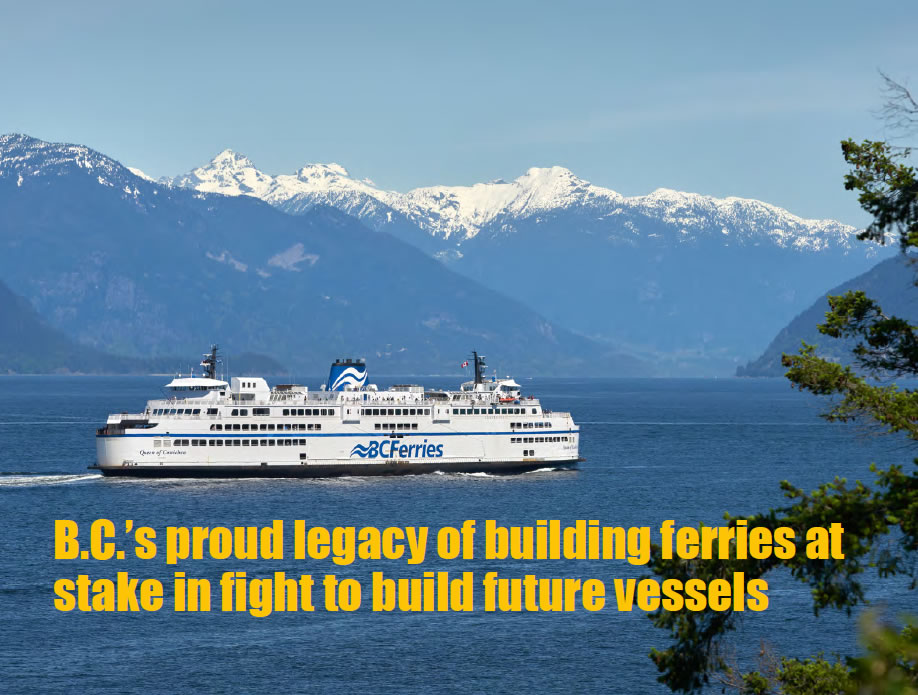
As the BC Building Trades launches a campaign to bring ferry building back to the West Coast, Venoit is frustrated that BC Ferries is sending contracts offshore to China for four new vessels to replace C-class ferries.
Unmooring from fast food and setting his anchors in the shipyard, Venoit said, was “probably one of the best changes I could have made in my life at that time.”
“I enjoyed the work, enjoyed the pace, enjoyed the meticulous nature in which the shipbuilding occurs,” he said. “There isn’t a lot of room to make mistakes in an environment like that. Because if you do, they’re prominent, and they take time to resolve.”
A mistake is bad in any setting, and nobody feels good about having to go back and fix their own error, much less someone else coming in to fix it.
But Venoit said the stakes can get even higher in shipbuilding, and not just because you’re dealing with a vessel carrying dozens or hundreds of people over a large body of water.
A fix that might take a few minutes in a house, he said, might take closer to a day on a ship.
“Working on a vessel is more of a permanent fixture, if you will, and so requires that extra bit of time to get it perfect,” Venoit said.
He described a ferry as a “floating city,” and that means it’s got all kinds of different types of electrical infrastructure to work on.
Throughout the project, an electrician might spend some time installing lights on the car deck, as well as on the electronic systems in the bridge, kitchen, engine room, passenger areas, or fire alarm and sprinkler system.
“It’s real harmonious-type work. You’re not just doing one little aspect of life,” he said.
Lee Loftus, a retired insulator and former Business Manager with Heat and Frost Insulators Union Local 118, would see BC Ferries from the moment they laid the keel in the shipyard through to dropping the completed vessel in the water.
“It’s pretty exciting to be able to do that and watch them launch this big vessel into the water,” he said.
And it was similarly exciting to work on vessels when they were pulled into drydock for work, “being able to walk under this huge, huge vessel.”
For as complicated as shipbuilding may be, though, B.C. is more than equipped for it.
And that’s what is so disappointing for many former shipbuilders, like Venoit, and those who would like to get into the industry: seeing a province with abundant workers and expertise shipping the work overseas.
Venoit recalls asking a chief engineer for a cruise ship several decades ago, where the best tradespeople are for shipbuilding.
“He immediately stated, ‘Hands-down, Canadian electrics and mechanics,’” Venoit said.
“Design? Italian, all the way. But [when] it comes to tradespeople, electrics and mechanics, he said, Canadian hands-down, around the world.”
Loftus agreed with that assessment.
“Burrard drydock in the shipbuilding industry in Canada, actually led the way on module constructions,” he said.
“It used to be built and laid piece by piece. We were building it in module constructions and putting it into place. We led the world construction… it’s really unfortunate we abandoned that. We could and should be world leaders.”
For both, the industry’s decline began in the 1990s with a series of blows.
Venoit pointed to a 1994 report by the BC Job Protection Commissioner and described the shipbuilding industry as a three-legged stool held up by the provincial government, the federal government and the private sector.
“If one of those legs were to ever come out from under the stool, the stool would fall over,” Venoit said. “And unfortunately, right at that time, BC Ferries decided that they were going to stop supporting shipyards in B.C.”
The federal government, too, had nothing in the pipeline for B.C., having just handed a contract to Halifax, leaving the private sector the lone support for B.C.’s shipbuilding industry.
The result, he said, was “an industry that was downsizing and attempting to right-size, and almost capsized.”
Loftus said the decision by the federal government not to subsidize the shipbuilding industry impacted him directly, particularly with the coast guard’s cancelled Polar 8 icebreaker contract.
“When that fell through and got cancelled, they closed down the shipyard. I was No. 1 in the seniority list of the insulation department, I was running a crew of 20, and the next day we were laid off,” Loftus said.
“I was in my early 20s when I started working there, and I thought I’d be there for life.”
Still, BC Building Trades president Al Phillips said the province still has a strong industry — one that could scale up to meet the demand should provincial and federal governments get serious about shipbuilding on the West Coast.
Phillips’ own trade, as a pipefitter, was born in shipyards.
“We have a long history at the shipyards — grandfathers and fathers and mothers and daughters of our members have been working there for… over 100 years,” he said, pointing in particular to the shipyard run by Seaspan in North Vancouver.
Those shipyards have built 13 major vessels in the last decade, Phillips said.
“When it comes to building ferries, we absolutely have the capacity to build. Ferries are not a complex vessel. We’ve built much more complex vessels for the Royal Canadian Navy. A ferry is really just a barge with a White Spot and a toilet on it,” he said.
“It’s a bit more complex than that, obviously, when you add all of the comforts and amenities and safety requirements that you need to have a vessel that transports people and products and vehicles. But it’s not as complex as some of the other vessels.”
While there have been shipyard closures over the decades, Phillips said B.C. has no shortage of waterfront property the federal government “could easily invest” in to rebuild that infrastructure.
And that investment would bring returns to the economy, he noted.
“When you build vessels here, people spend their money on groceries and gas,” Phillips said.
BC Building Trades has been pushing for more action to that end, with both provincial and federal governments — and the public sentiment is on their side.
The trade war waged by the U.S. has only added wind to its sails.
The backlash to BC Ferries’ June announcement that it would be sending a contract to replace its C-class vessels out to China has lasted months. While politicians have been hesitant to take responsibility for intervening, the contract has, at least publicly, drawn the ire from across the political spectrum.
That includes those in the B.C. and federal governments, with Premier David Eby saying he’s “not happy” with the contract.
BC Ferries has said no Canadian companies put in a bid for the work, but two shipyard owners said the procurement, which prioritizes the lowest bidder, will often favour places like China.
“The only reason we’re buying from China is [that] it’s cheap. But what comes with that?” he asked, pointing out the lack of labour laws or human rights records with countries like China.
Phillips said it’s not too late for the government to change course on the ferry building contract, noting most contracts have some clause allowing the parties to cancel out.
He added that politicians should be receptive to the messaging around building ferries in B.C. because they’ve been preaching similar lines themselves.
“They’re telling their own internal procurement officers not to buy any water bottles in the United States, but they can buy an entire ferry from China,” Phillips said.
“It doesn’t match. The politics don’t match.”
Today, Venoit rides the ferries regularly — he was fresh off a ferry when he spoke to Tradetalk — and the ships bring back plenty of memories.
Thinking back nearly half a century, Venoit recalls the camaraderie between the workers. And he remembers the rusty colour that’s all around you, “like a blank canvas,” when the steel’s all primed and in place.
But it also brings up a feeling more akin to mourning.
“I see the last 20 years, the ferry industry, the shipbuilding industry, as collateral damage,” he said.
In that collateral damage, Venoit sees a loss of opportunity — and not just business opportunities, but opportunities for trades workers.
Venoit described an “incredible emotional upset” when he thinks about the industry today and what the province has lost. That includes an “incredible amount of intelligence that went into that whole industry, which created a whole bunch of really good tradespeople.”
“It had such an impact on my life growing up as an 18-yearold kid coming into an industry that I thought was probably going to be the last union industrial bastion in the South Island,” he said.
“And it’s essentially swept from under us, all because of political fodder.”
By Dustin Godfrey